
How much is 1 UNI?
One UNI is worth $3.30 — the UNI-to-USD rate as of 2026-08-19 04:45 UTC, +1.31% over the past 24 hours. The figure on this page refreshes hourly from CoinMarketCap data.
BAKED FROM THE HOURLY RATE AS OF 2026-08-19 04:45 UTC · NOT A LIVE CALCULATOR
UNI vs. other DeFi coins
| Asset | 24H | 7D | 30D | 90D |
|---|---|---|---|---|
| Uniswap UNI THIS PAGE | +1.31% | −12.76% | −5.20% | −10.02% |
| Bitcoin BTC | +0.22% | +0.92% | −0.60% | −17.47% |
| World Liberty Financial WLFI | −0.19% | +8.11% | +5.74% | −3.72% |
| Aster ASTER | −0.14% | −0.97% | −3.24% | −12.86% |
AS OF 2026-08-19 04:45 UTC · DATA: COINMARKETCAP · DEEPER TINT = LARGER MOVE · 90D IS OUR LONGEST SNAPSHOT WINDOW
UNI price context
Uniswap's all-time high is $44.92, reached on May 3, 2021. At today's price of $3.30, UNI trades 92.7% below that peak. Its lowest recorded price was $1.03 on September 17, 2020.
Over the past 30 days UNI has moved −5.20% and over the past 90 days −10.02%.
Circulating supply is 623,864,424 UNI , with no fixed maximum supply. UNI launched with a 1 billion supply, fully vested to team, investors, and community over four years (complete since 2024), with 2% perpetual inflation available to governance thereafter. With vesting done, supply surprises are minimal — the token's story is about fee capture, not unlocks.
Uniswap all-time high
The gap to the record
Getting back to $44.92 from here would take a 13.6× move — that multiple, not the percentage, is the honest way to read a drawdown. The figure above updates every hour as our price snapshot refreshes; the record itself is an editorial fact recorded from CoinGecko.
All-time low
Uniswap's recorded all-time low is $1.03, on September 17, 2020 (CoinGecko). From that low to today's price is the other end of the same story — aggregators differ on launch-era data, so we name the source we cite.
Uniswap price history
Our sourced price record for Uniswap begins in 2020 — the coin may have traded earlier, but we list only years we can back with a citable source. Its all-time high is $44.92 (May 3, 2021), its recorded low $1.03 (Sep 17, 2020), and it trades at $3.30 today. Every row below names where its figures come from.
Uniswap price by year
Rows from 2020 through 2023 are editorial records — each cites the source it was taken from. Rows from 2024 onward are computed from our licensed CoinMarketCap daily data; for those years, high and low are the highest and lowest daily closes in our series, not intraday extremes.
| Year | Open | High | Low | Close | Source |
|---|---|---|---|---|---|
| 2020 | $3.86 | $8.67 | $1.76 | $5.16 | Coinbase (UNI-USD) |
| 2021 | $5.16 | $45.02 | $4.35 | $16.98 | Coinbase (UNI-USD) |
| 2022 | $17.01 | $19.87 | $3.32 | $5.16 | Coinbase (UNI-USD) |
| 2023 | $5.16 | $8.26 | $3.60 | $7.23 | Coinbase (UNI-USD) |
| 2024 | $7.35 | $18.39 | $5.38 | $13.17 | Our CMC data |
| 2025 | $13.27 | $15.11 | $4.67 | $5.95 | Our CMC data |
| 2026YTD | $5.67 | $6.18 | $2.43 | $3.30 | Our CMC data |
What moves Uniswap's price
- The fee switch: Uniswap's contracts can divert a share of pool fees to UNI stakers; every governance push toward activating it has repriced the token sharply, and every stall has done the reverse.
- Regulatory posture toward DeFi: the SEC's Wells notice to Uniswap Labs (2024) and its subsequent closure without action bracketed the range — enforcement risk off is a direct UNI catalyst.
- DEX volume share versus centralized exchanges: Uniswap's fees scale with on-chain trading volume across Ethereum, its L2 deployments, and Unichain.
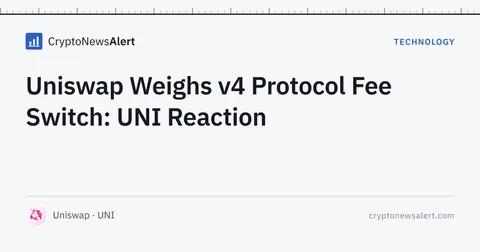
- v4 and Unichain adoption: v4's 'hooks' architecture (customizable pools) and Uniswap's own L2, Unichain, are attempts to widen the moat — their uptake is measurable in migrated liquidity.
- Broad DeFi sentiment: as the bluest-chip DeFi governance token, UNI trades as the sector proxy in both directions.
“Uniswap's contracts can divert a share of pool fees to UNI stakers; every governance push toward activating it has repriced the token sharply, and every stall has done the reverse.”
About Uniswap
Uniswap was created by Hayden Adams, a laid-off mechanical engineer who taught himself Solidity and shipped v1 in November 2018 from an idea in a Vitalik Buterin post. Its automated-market-maker design — liquidity pools priced by formula instead of order books — became DeFi's foundational primitive.
v2 (2020) added token-to-token pairs, v3 (2021) concentrated liquidity, and v4 (2025) introduced hooks that let developers customize pool behavior. The UNI token appeared in September 2020 via a retroactive airdrop of 400 UNI to every past user — a defining moment for token distribution norms. Uniswap Labs has since launched Unichain, an OP Stack L2 built around the protocol, while governance of the protocol itself sits with the Uniswap DAO.
UNI tokenomics
Supply launched at 1 billion UNI: 60% to the community (airdrop, liquidity mining, treasury), 21.3% to the team, 18% to investors, and the small remainder to advisors, all vested over four years ending 2024. Governance may mint up to 2% per year thereafter but has not done so. UNI's central economic question is the fee switch: the protocol generates large fee revenue for liquidity providers, and governance controls whether a portion is redirected to the token.
How to buy Uniswap
UNI is listed on all major exchanges, including Coinbase, Kraken, and Binance — and, fittingly, trades with deep liquidity on Uniswap itself for anyone using a self-custody wallet. Holding UNI in self-custody allows delegating votes in Uniswap DAO governance.
Uniswap news
All coverage →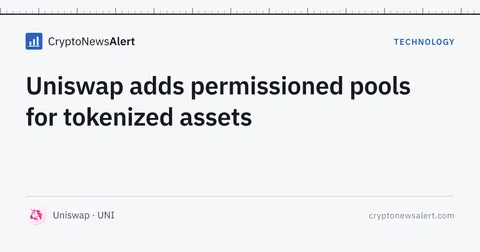
Uniswap FAQ
What is an automated market maker (AMM)?
A trading design where prices come from a formula over pooled liquidity rather than from matched buy and sell orders. Anyone can deposit tokens into a pool and earn fees from traders; Uniswap made this model the default for on-chain markets.
What is the Uniswap fee switch?
A built-in option for governance to redirect a fraction of trading fees from liquidity providers to the protocol — potentially to UNI stakers. It has never been switched on protocol-wide; proposals to activate it are the most market-moving events in UNI's history.
Does UNI entitle holders to Uniswap's revenue?
Not currently. All pool fees go to liquidity providers. UNI is a governance token whose holders could vote to change that — which is precisely why fee-switch proposals move the price.
What was the UNI airdrop?
In September 2020, Uniswap gave 400 UNI to every address that had ever used the protocol — around 250,000 users. It set the template for retroactive airdrops and was worth over $1,000 per user on day one.
What is Unichain?
An Ethereum layer-2 built by Uniswap Labs on the OP Stack, launched in 2025 and optimized for DEX trading with fast blocks and MEV protections. It gives the protocol its own venue rather than renting blockspace elsewhere.
What is Uniswap's all-time high?
Uniswap's all-time high is $44.92, reached on May 3, 2021 (source: CoinGecko).
How far is UNI from its all-time high?
As of 2026-08-19 04:45 UTC, UNI trades at $3.30 — 92.7% below its all-time high. Reaching the ATH again would require a 13.6× move. This figure refreshes hourly with our CoinMarketCap data.
What was Uniswap's lowest price ever?
Uniswap's recorded all-time low is $1.03, on September 17, 2020 (source: CoinGecko). Aggregators can differ on launch-era data; we cite the source shown.
Will UNI reach a new all-time high?
We don't publish predictions. What can be said factually: UNI trades 92.7% below its all-time high, and this page tracks that gap with hourly-refreshed data.
Related
Price data: CoinMarketCap, refreshed hourly. Last updated: August 19, 2026, 04:45 UTC. Historical figures (all-time high/low) are recorded at page creation and reviewed periodically.
This page is factual information, not financial advice.