Bitcoin BIP-110 Fork Deadline: What the Price Data Shows
What BIP-110 Is And Where It Lives
The fork fight now drawing attention among exchanges and miners centers on a proposal that is formally tracked in Bitcoin’s development process. BIP-110 is maintained as a dedicated directory (bip-0110) in the official Bitcoin Improvement Proposals repository, the canonical archive where proposal text and specifications are published.
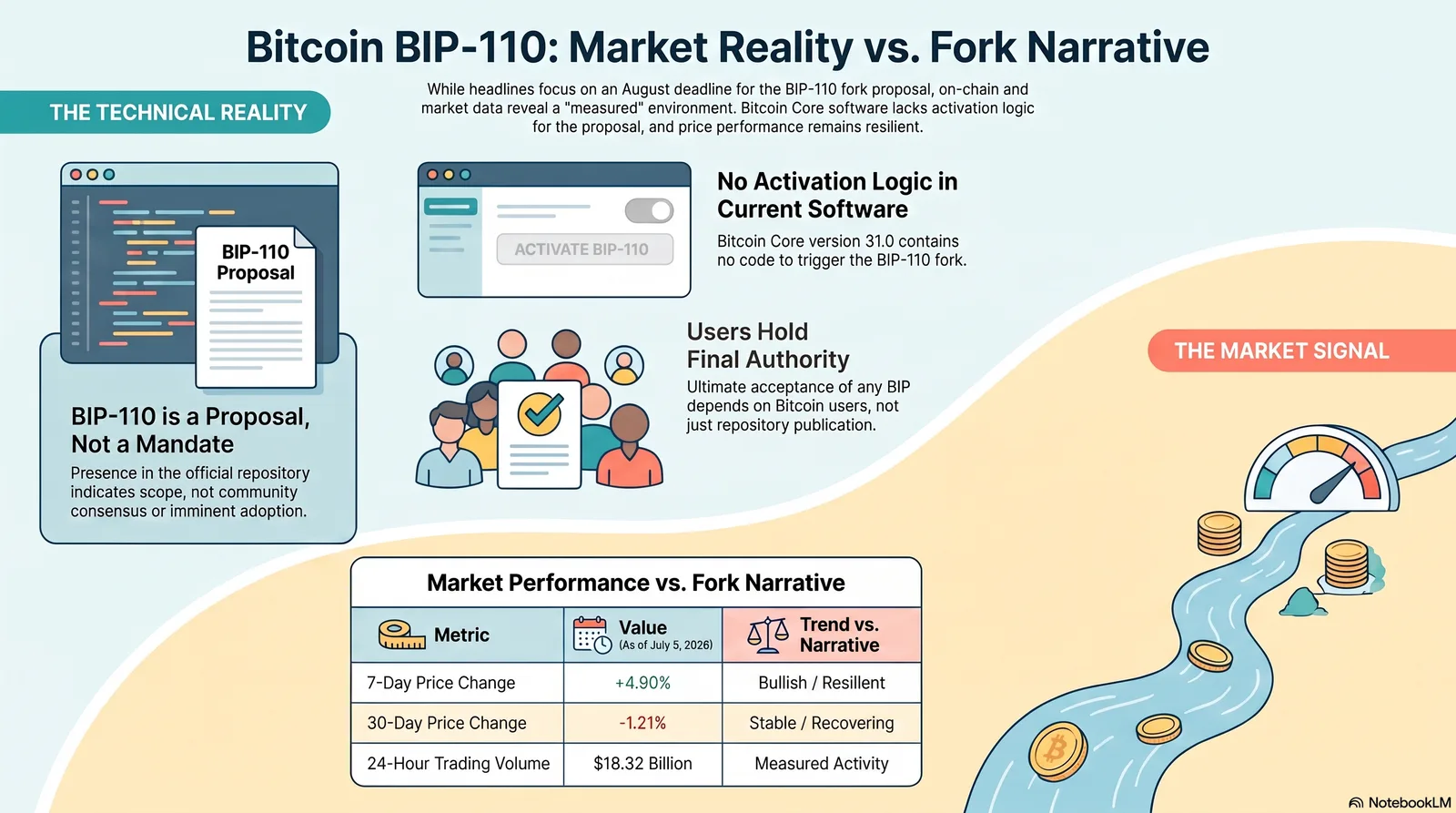
It is worth being precise about what publication means. The BIPs repository index states plainly that “having a BIP published here indicates that the proposal is in scope and has met other formal criteria for this repository, but does not indicate that it is a good idea, has community consensus, or that it is about to be adopted.” The same document notes that “ultimately acceptance and adoption rests with the Bitcoin users,” a reminder that a numbered proposal is a starting point for debate, not a settled outcome. That distinction matters when a deadline narrative frames a proposal as though activation were imminent.
No Activation In Shipped Bitcoin Core Releases
Consensus rule changes reach the network through client software, so the release history is a useful reality check. The Bitcoin Core releases page lists version 31.0 as the most recent release, and the GitHub releases feed shows 31.0 was published on 20 April, alongside maintenance releases such as 30.2, 29.3 and 28.4. Anyone weighing exchange or mining posture ahead of a deadline can verify against these signed, deterministically built releases rather than second-hand summaries.
How The Market Actually Reacted — The Numbers The Narrative Lacks
The wire story frames an August deadline as a source of tension for the market. Our licensed CoinMarketCap data lets us replace that framing with figures. As of the latest snapshot, Bitcoin trades at about $62,983, according to our CoinMarketCap data.
The short-term moves do not read like stress. Over the prior 24 hours BTC is up 0.31%, and over seven days it is up 4.90%, per our CoinMarketCap data. A near-5% weekly gain is not the profile of a market pricing in imminent disruption from a contested fork; it is the profile of an asset grinding higher through the period the debate intensified.
Step back to 30 days and the picture is roughly flat-to-slightly-negative: BTC is down 1.21% over that window, per our CoinMarketCap data. Put the two horizons together and the interpretation is straightforward — most of the monthly softness was recovered inside the last week, so whatever the fork discussion has contributed, it has not translated into sustained downside over the month.
Liquidity And Scale Around The Deadline
Depth matters as much as direction when a governance event looms, because thin markets amplify shocks. Bitcoin’s 24-hour trading volume stands at roughly $18.32 billion against a market capitalization of about $1.26 trillion, according to our CoinMarketCap data. That works out to turnover of roughly 1.45% of market cap in a single day — active two-way trade rather than the volume spike or collapse that typically accompanies a genuine forced-decision moment for exchanges and miners.
For context on scale: a $1.26 trillion market cap is the base that any chain split or contested activation would have to contend with. The larger and more liquid the market, the more costly and less likely a disorderly outcome, because the economic majority the BIPs documentation points to is spread across deep order books rather than concentrated in a few thin venues.
What To Watch Next
The verifiable signals are narrow but concrete. First, the BIPs repository itself — the status and content of bip-0110 is the authoritative record of the proposal, not commentary about it. Second, the Bitcoin Core release notes, which is where any activation logic would actually appear before it could bind exchanges or miners. Third, the market internals we track through our CoinMarketCap feed on the Bitcoin price page: watch whether 24-hour volume expands sharply relative to the current ~1.45% of market cap, which would be the first quantitative sign that traders are repositioning around the deadline rather than treating it as noise.
For now, the data undercuts the drama. A 4.90% weekly gain, a 1.21% monthly dip and steady multi-billion-dollar turnover describe a market that is watching the layer-1 governance process without repricing for a crisis. The debate over BIP-110 is real and worth following on its technical merits, but Bitcoin’s traded price has, so far, stayed measured.
Coins in this story
Sources
Reporting is drawn from the primary sources listed above and CryptoNewsAlert's own licensed CoinMarketCap price data. See our editorial & data policy for how articles are produced and reviewed.
Nothing on this page is financial or investment advice. Cryptocurrency prices are volatile; do your own research.